Remove Swirl Marks, Water Spots & Oxidation — Springfield & Eugene, OR
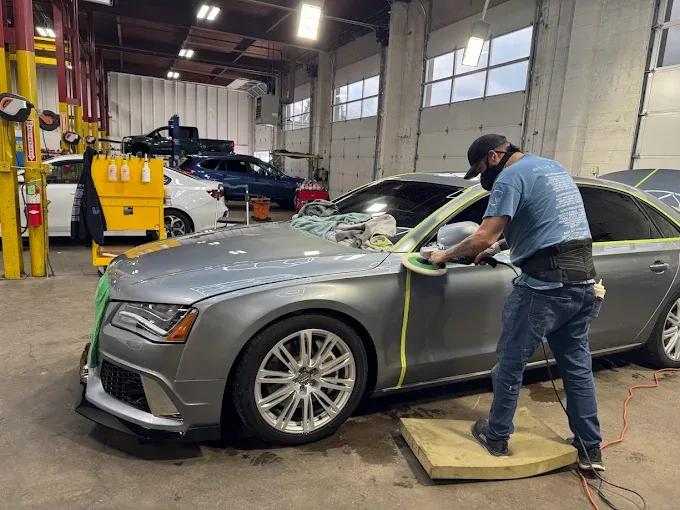
Paint correction uses machine polishing with calibrated compounds to remove swirl marks, water spot etching, and clear coat oxidation. A digital paint thickness gauge is used before and during every correction to ensure the clear coat is never polished past safe limits. The result is often sharper paint clarity than the factory finish.
Paint correction is machine polishing that removes swirl marks, water spot etching, and oxidation from your vehicle's clear coat. If your paint looks hazy in direct sunlight, shows a circular web under a parking lot light, or came back from the auto wash looking worse than before — this is the service that fixes it. Before we touch any car, Tristan measures the clear coat thickness with a digital gauge. That reading tells us how much material we can safely remove and whether correction is the right call at all. Call (541) 337-9893 for a free assessment.
Before You Book
What to do instead
Deep scratch through the clear coat: touch-up paint for chips, panel respray for larger damage — we can point you to a local body shop. Failing clear coat: respray is the only permanent solution. Light surface haze with no real swirling: a decontamination wash and paint sealant may be all you need — we'll tell you honestly which one fits at your free assessment.
Step by Step
Before any polishing begins, Tristan measures the clear coat on every panel with a digital gauge. Factory clear coat runs 100–150 microns. The reading tells us safe polishing depth and flags panels with prior bodywork that come in thinner. Below roughly 60–80 microns, the risk of cutting through to the base coat rises sharply — we stop and tell you before any correction happens on that panel.
Polishing over contamination drives it further into the clear coat. Before a machine touches the paint, the car gets a full decontamination sequence: pH-neutral shampoo, iron fallout remover (watch it turn purple as it pulls brake dust and ferrous particles out of the surface), and a clay bar pass to remove anything chemically embedded. Paint should feel like glass before the first polisher comes out.
For vehicles with heavy swirls, deep water spot etching, or oxidation, we start with a cutting compound and the appropriate pad. This is the aggressive step — removing the bulk of defects by leveling the clear coat surface. We re-check thickness on panels where we're cutting heavily. No step is skipped to save time.
A medium polish removes compound trails and micro-marring from the cut stage and builds gloss. Vehicles with lighter defects may skip the heavy cut entirely and start here. We assess the paint after decontamination and set the plan before charging for stages that aren't needed.
Ultra-fine polish on a soft finishing pad maximizes clarity and removes holograms — the circular DA polisher marks that are invisible under shop fluorescents but show as a cloudy swirl under a single LED. Most shops don't check for these. We eliminate them on every correction.
An IPA panel wipe removes all polish oils so the true result is visible. Tristan checks every panel under the LED bay — the only light source that reveals holograms, remaining swirls, and real gloss quality. The car doesn't move until that inspection is done.
Pricing
Price is set by vehicle size, defect severity, and which correction stages are needed. We assess the paint after the decontamination wash and confirm the plan before you commit to anything. What we quote before the job is what goes on the invoice — no surprise add-ons.
In Lane County
Most swirl marks we see in Springfield trace back to two sources: automatic tunnel car washes and improper hand washing — single bucket, wrong towel, or wiping a dry dirty panel. The tunnel washes do the job of removing bulk dirt, but the brushes leave a predictable swirl pattern on soft paint that only shows in direct light. In spring, Willamette Valley grass seed pollen settles on wet paint and begins etching the clear coat if it isn't washed off within a few days. By early summer we see a steady stream of vehicles that need both decontamination and correction from the season's pollen accumulation.
Street-parked vehicles under oak and maple canopy in older Springfield and Eugene neighborhoods take a different kind of damage: sap that hardens in July heat, bird drops that etch clear coat within hours in direct sun, and light contamination that accumulates slowly and fills the surface. Correction resets all of it.
FAQ
A single-stage paint correction on an average-sized vehicle takes 4–6 hours. A full two-stage or three-stage correction — which we recommend before ceramic coating — typically takes a full day (8–10 hours) depending on paint condition and vehicle size. Larger vehicles like trucks and SUVs take longer. We don't rush correction work because thoroughness is what produces the result.
A basic polish is a single-step treatment that improves gloss and removes very light surface marks. True paint correction is a multi-stage machine polishing process using progressively finer compounds and pads, calibrated to your paint's specific thickness and defect depth. Correction removes a measurable percentage of defects — swirls, scratches, water spots, oxidation — while a basic polish just enhances gloss without addressing real paint damage.
Yes — and this is important. Ceramic coating doesn't correct paint; it permanently locks in whatever condition the paint is in at the time of application. If you apply ceramic coating over scratched or swirled paint, those defects become permanent and very difficult to address afterward without removing the coating. We always recommend at minimum a thorough decontamination, and ideally a correction pass, before any ceramic coating job.
Not all. Paint correction removes defects in the clear coat — swirls, water spot etching, light oxidation, and surface scratches. The test: drag your fingernail across the scratch. If it catches, the scratch goes through the clear coat into the base coat and won't polish out — that needs touch-up paint or a panel respray. We check every scratch during the assessment and tell you what correction will and won't address before we quote.
Done properly, no. Done carelessly, yes — polishing aggressively on thin clear coat can burn through to the base coat, which requires a respray to fix. The safeguard is a digital paint thickness gauge: we measure every panel before and during the correction. If a reading falls below safe cutting depth on any panel, we stop and tell you before doing anything. A shop that skips this step is guessing with your paint.
It depends on starting clear coat thickness and how aggressively each correction was performed. Factory clear coat runs 100–150 microns; a careful correction removes roughly 2–8 microns depending on the stage. Managed properly, most vehicles can go through 4–6 corrections over their life before the clear coat becomes too thin to safely polish. We track thickness readings on every correction job — that record is what makes an honest answer to this question possible.
Where We Serve
Our shop is located at 3436 Olympic Street in Springfield, OR — accessible from communities across Lane County. Drop off your vehicle or call for details.
Blue Rose Auto Detailing Services — Suite 100, 3436 Olympic Street, Springfield, OR 97478 — (541) 337-9893
Fair pricing, honest work, owner-inspected quality since 1994.
(541) 337-9893Owner-operated since 1994 · Springfield, OR · No surprise charges